
 All news
Does a Faster Road Marking Truck Always Mean Higher Efficiency? How Should Construction Efficiency Be Evaluated on Large Road Projects?


When road construction contractors evaluate road marking equipment, they often pay attention to one very intuitive figure: operating speed. How far can a road marking truck work in one hour? What is its maximum operating speed? These figures may appear to provide a direct way to judge equipment efficiency. However, when working on highways, national roads, provincial roads, and other large projects, the amount of road marking actually completed each day cannot simply be equated with the theoretical operating speed of the vehicle.
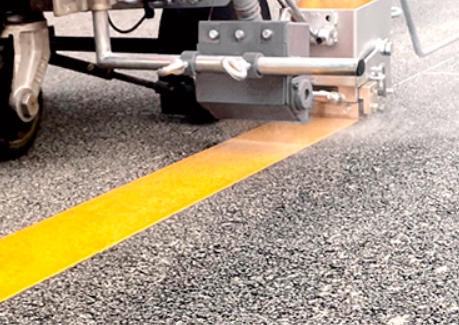
Even if a piece of equipment can apply road markings at a relatively high speed, if it needs to stop frequently to wait for materials, adjust equipment, or coordinate with other construction procedures, the amount of time actually spent on effective marking work will still be limited. Therefore, for large road projects, the real concern should not only be “how fast can the equipment operate?” but also whether the equipment can maintain stable and continuous operation for a long period of time.
For contractors, the amount of effective work actually completed each day is often more meaningful than the maximum speed that the equipment can achieve at a particular moment.
Taking thermoplastic road marking construction as an example, the material needs to go through the corresponding preparation process before formally entering the road marking stage. The entire construction process is not completed independently by the road marking truck. Instead, material preparation, supply, and road marking application need to work together continuously.
If a large road marking truck has strong application capacity but the upstream material preparation and supply cannot keep up, the equipment may need to stop and wait for material after completing a section of work. In this situation, even if the theoretical vehicle speed is further increased, the overall project efficiency cannot be improved because the factor limiting construction progress is no longer the road marking truck but a slower part of the entire system.
Therefore, in large road marking projects, material preparation, transportation and supply, and road marking equipment need to be reasonably matched according to the expected construction volume. Only when the entire construction process can operate continuously can the capacity of the road marking equipment be more effectively converted into actual daily output.
As the scale of road projects increases, the amount of equipment and the number of personnel involved at the construction site also increase. If different procedures rely entirely on separate equipment and personnel, waiting time between each procedure may gradually accumulate. Therefore, the development of large road marking equipment is not simply about making the equipment “larger.” Coordination and integration between different construction functions are also becoming increasingly important.
For construction companies, the real value of this development is to reduce certain repetitive operations and construction waiting times, allowing personnel to focus more effectively on road marking work. Equipment configuration should also be determined according to the company's actual business rather than simply based on the number of functions or the size of the vehicle.
WELL-ROAD focuses on road marking machinery and related equipment, including road marking trucks, ride-on marking machines, removal and cleaning trucks, crash cushion trucks, and other road construction equipment. This terminology and brand positioning are consistent with TATU Highway Group's official English website. For projects with relatively large workloads, equipment selection especially needs to consider the material system, planned daily construction volume, and actual jobsite conditions.
Not all road marking projects involve newly constructed roads. As roads remain in service over time, some projects require existing road markings to be replanned or renewed. In these cases, existing markings may first need to be removed before subsequent road marking work can be carried out.
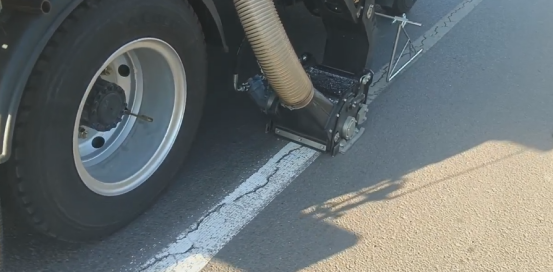
If the operating capacity of road marking removal equipment differs significantly from the speed of subsequent marking work, the removal process and the new marking process may end up waiting for each other. Therefore, for road maintenance projects, project efficiency should not only be calculated based on how many kilometers the road marking equipment can complete. The time required for existing marking removal, pavement preparation, and new marking application should also be considered.
From this perspective, the significance of mechanized road construction is not to make one particular machine faster, but to allow different stages of the entire project to form a more reasonable construction rhythm.
Large equipment does not necessarily mean that it is suitable for every construction company. If a company mainly undertakes highways, national and provincial roads, and long-distance road marking projects, continuous operating capability and large-scale mechanized equipment may have greater value. If the company's main business consists of localized road maintenance or small-area construction, a more flexible equipment configuration may be more suitable.
Therefore, before purchasing road marking equipment, several basic questions can first be clarified: What types of roads does the company mainly work on? What road marking materials are mainly used? What is the approximate annual project volume? What types of lines need to be applied? How long will the equipment actually be used each year? Once these requirements have been clarified, selecting the appropriate equipment is more reasonable than simply comparing engine specifications, vehicle dimensions, or maximum operating speed.
For road construction companies, a truly suitable piece of equipment is not necessarily the one with the largest specifications, but the one that can work effectively with the company's project scale, material system, and construction method. The purpose of large road marking machinery is ultimately not simply to “mark faster,” but to maintain a stable, continuous, and efficient construction process under relatively large project volumes.