
 All news
How to Select Mechanized Marking Equipment for Large‑Scale Road Marking Projects: A Complete Breakdown from Construction Efficiency to Equipment Configuration


As highway, national and provincial highway, and urban road marking construction gradually develops toward mechanization and continuous operation, the tasks undertaken by roadmarking equipment go far beyond merely “painting lines on the road”.
For professional construction contractors, whether a largescale roadmarking truck is truly suitable for a project hinges on the entire construction workflow: whether material supply can keep pace, whether longdistance construction can maintain stability, whether solidtodashed line switching is convenient, whether glassbead spreading is uniform, and whether the equipment can cut down frequent stops and manual operations during construction.
Therefore, when selecting equipment for largescale roadmarking projects, simply comparing engine power, maximum travelling speed or purchase price is of limited practical significance. What actually determines project progress is the continuousoperation capacity of equipment under realworld construction conditions.
WELLROAD’s current professional roadmarking equipment product portfolio is developed following exactly this logic, covering hotmelt, twocomponent and largesize roadmarking trucks with diverse operating configurations. For construction contractors, there is no simple “betterorworse” ranking among different models. The core consideration is what specific problems need to be solved for a given project.
From “StandAlone Marking”to“Continuous Construction”: What Are the Real Challenges for LargeScale Projects?
In smallscale construction, a severalminute pause for material refilling barely affects the overall project schedule. Yet the situation changes completely when construction stretches over dozens of kilometres or more.
Once marking speed increases, frontend material supply capacity must rise correspondingly. Insufficient melting capacity, inefficient material delivery, or mandatory stops for material refilling after each construction segment will result in intermittent operation cycles: marking → waiting for materials → refilling → resuming construction → waiting again.
Hence, a key concept for largescale hotmelt marking construction should be established: construction efficiency is not defined by how fast the machine travels, but by how long the complete equipment set can work continuously. This is the major driver behind the trend for large roadmarking trucks toward largecapacity tanks, continuous material feeding and multiprocess integration.
For instance, certain models within WELLROAD’s large hotmelt roadmarking equipment integrate highvolume material melting, marking control and relevant auxiliary construction functions onto one vehicle platform. For longdistance road projects, the core value of such configurations lies not in stacking extra functions, but in minimizing downtime and redundant operations on site.
Q1: For highway projects requiring dozens of kilometres of marking in one go, which parameter of a marking truck matters most?
Maximum construction speed alone is not the answer. For longdistance projects, effective construction efficiency deserves higher priority. It encompasses melting capacity, coating tank volume, continuous feeding performance, normal operating speed, refillingstop frequency, and transition efficiency between different work processes.
Take two pieces of equipment with similar theoretical marking speed as an example. If one requires frequent refilling stops while the other supports extended continuous runs, their actual daily output can differ substantially.
Accordingly, when soliciting quotations, instead of merely asking “what is its maximum speed”, contractors should raise more practical questions: What is the effective daily output under normal working conditions? How many stops are required per day? How many supporting personnel and auxiliary units are needed? These questions reflect realworld operating costs far better.
The value of a large roadmarking truck is more than a marking unit mounted on a truck chassis. Professional roadmarking construction involves multiple working procedures. Prior to formal marking, surface preparation and construction positioning are often required. During marking operations, material feeding, mark forming, glassbead spreading and solid/dashedline regulation all come into play.
If every step relies on separate vehicles and crews, construction organization grows increasingly complex as project scale expands. One development direction for large roadmarking trucks is to integrate as many mechanizable procedures as practicable.
Take the WELLROAD WRD5263THX roadmarking truck as an example. Beyond road marking itself, it is fitted with a hydraulic sweeper and premarking calibration device, supporting surface cleaning, premarking layout and undercoating spraying. An intelligent marking control system manages line patterns and construction parameters. For largescale projects, the real merit of such design lies in cutting repeated equipment handoffs and streamlining workflows for maximum continuity.
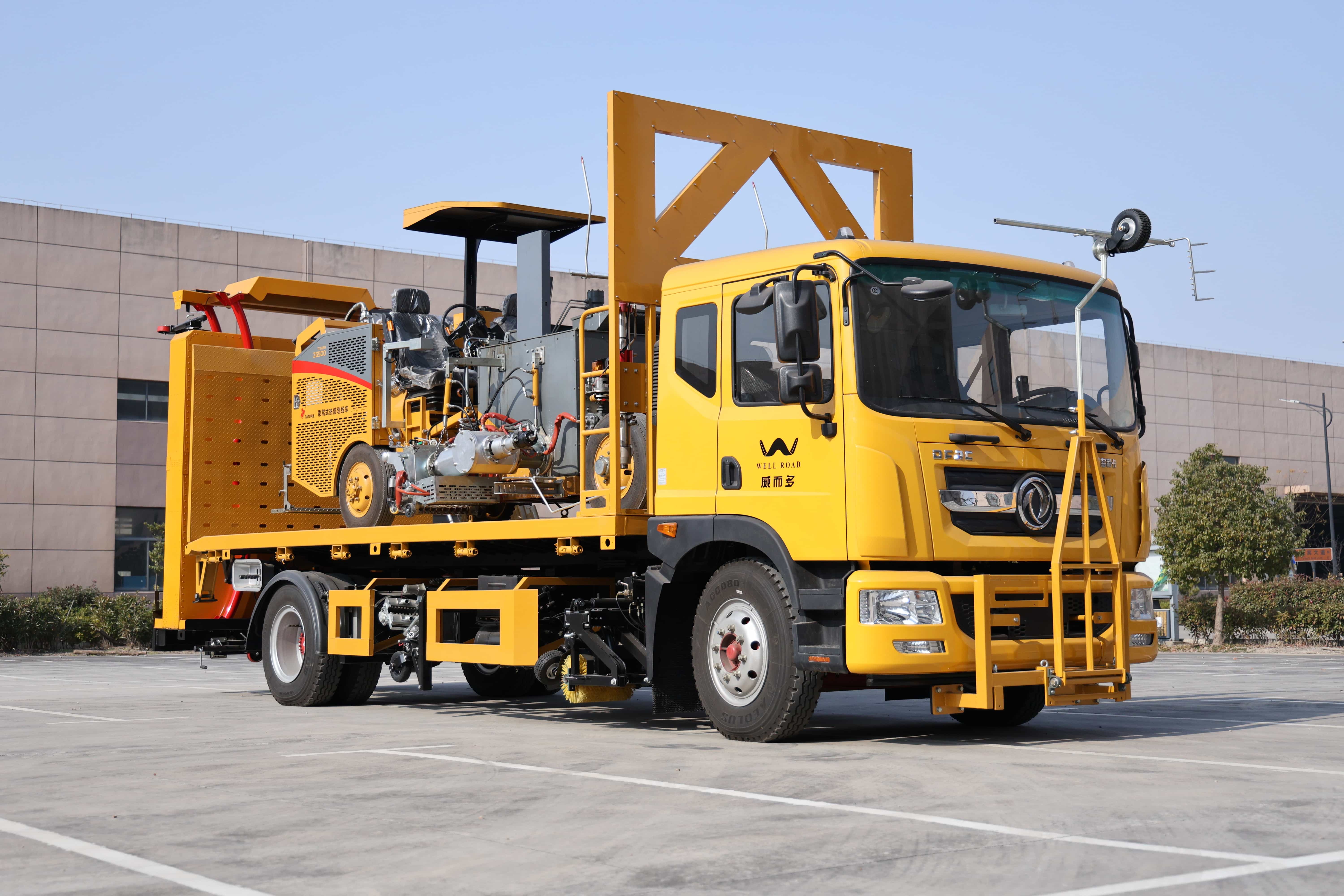
In other words, when procuring large marking trucks, do not just count feature quantities. Instead, evaluate whether those functions genuinely reduce the number of construction vehicles, staffing requirements or waiting time.
Solid Lines, Dashed Lines and Special Markings: Diverse Demands Placed on Equipment
Highway and urbanroad projects seldom feature uninterrupted solid lines from start to finish. Solid lines, dashed lines and varied structured markings frequently coexist. Frequent manual adjustments or hardwareswap stops drastically reduce productivity for longdistance work.
Therefore, for contractors undertaking mixed roadmarking projects, equipment versatility for different line patterns and patternswitching efficiency carry great weight.
Some of WELLROAD’s hotmelt roadmarking trucks can handle standard flat lines as well as special structured markings such as chessdot lines, checkerboard lines and stairshaped lines via dedicated control modules and working attachments.
Here, “the more functions the better” is not the golden rule.
Contractors consistently working on only one standard marking type need not invest heavily in rarelyused lowfrequency functions. In contrast, for contractors regularly delivering comprehensive highway and municipal projects, multitask capability directly improves equipment utilization rate.
Q2: Can one large marking truck handle solid lines, dashed lines and special markings simultaneously?
Compatibility depends on the control system and working attachments of the specific model; do not assume all large marking trucks can achieve this.
Before procurement, define the line patterns you commonly execute and ask suppliers to verify each item below:
Capability for standard solidline marking;
Control of dashedline segment length and spacing;
Adjustability for varied marking widths;
Whether hardware replacement is mandatory for special structured markings;
Time consumed for pattern switching.
For contractors, valuable features are those required onsite, not the longest feature list on specification sheets.
HotMelt versus TwoComponent Projects: Different Procurement Rationales Apply
One easily overlooked aspect for largescale roadmarking projects:
Material system dictates equipment requirements.
Hotmelt construction emphasizes material melting, temperature retention, delivery and continuous feeding.
Twocomponent construction additionally demands reliable dualcomponent delivery, proportioning, mixing, spraying and postjob equipment cleaning.
Two trucks with similar exterior dimensions may adopt entirely internal systems. WELLROAD designs hotmelt and twocomponent roadmarking trucks as distinct product lines. Contractors focused on twocomponent projects should prioritize materialhandling systems rather than merely comparing chassis, engines or marking speeds.
Q3: Can an ordinary roadmarking truck be directly deployed for twocomponent marking projects?
There is no blanket yesorno answer. Compatibility with specific twocomponent construction processes must be validated. Twocomponent work involves strict component proportioning. Preproject verification should cover stable material delivery, ratiocontrol accuracy, construction methodology and postoperation equipment maintenance. These considerations outweigh maximum travelling speed for project procurement. Mismatch between equipment and material systems causes far graver consequences than low speed: defective mark formation and unstable field performance may occur.
Intelligent Technology Mitigates HumanInduced Variability in LongDistance Construction
Largescale road construction differs markedly from smallscale carpark lot marking through massive repetition. Operators relying on empirical parameter control produce negligible errors over short stretches. Over dozens of continuous kilometres, however, variations in operator fatigue, driving speed and repeated manual adjustments accumulate and get amplified.
Intelligent controls fitted on modern large marking trucks are not cosmetic gimmicks for “advancedlooking” hardware. Their purpose is to standardize repetitive operations previously heavily dependent on operator experience.
Systemdriven control over solid/dashedline segment length, spacing and other pattern parameters helps suppress humancaused deviations during extended shifts.
For governmentfunded projects and largescale contracting works, such capabilities ultimately translate into two core metrics: marking consistency and overall construction efficiency.
Purchase Price Is Only One Component of Total Cost of Ownership
Given the high capital outlay for professional large roadmarking trucks, contractors tend to fixate on upfront purchase quotations. Over longterm operation, total equipment costs comprise multiple elements: acquisition cost, operator labour, supporting auxiliary vehicles, fuel consumption, materialrelated downtime, maintenance and repairs, consumable spare parts, transportation and mobilization, plus equipment idle time.
A lowerpriced unit requiring extra auxiliary vehicles, more onsite personnel and frequent materialrelated waiting may generate higher cumulative costs across years of service. Conversely, highspec large trucks are not always costeffective.
If an enterprise only executes a small number of largescale projects annually and keeps highend equipment idle most of the time, heavyduty configurations will become a financial burden.
Summary: Higher Specifications Do Not Equal Better LargeScale RoadMarking Trucks
For highway, nationalprovincial highway and major urban roadmarking projects, markingtruck selection should not focus solely on purchase price, engine power or maximum construction speed. What truly governs project performance are material supply reliability, continuousoperation performance, linepattern control, construction stability and the overall fit between equipment and project requirements.